


Professional Kinetic Lighting Installation and System Setup Services
FENG-YI supports venue owners, production companies, integrators, and contractors with kinetic lighting installation planning, fixture setup, DMX signal coordination, system testing, and technical handover. We work from approved project information and confirmed equipment specifications, helping local installation teams prepare the venue, organize system connections, verify control functions, and move toward commissioning with clear responsibilities.
Safe, Coordinated Installation from Entry to Handover
Installation should follow approved drawings, confirmed product data, venue rules, and local safety requirements. FENG-YI can support scope clarification, equipment information, connection planning, setup guidance, and technical communication. Qualified local professionals remain responsible for structural approval, rigging, electrical work, high-altitude operations, fire-safety compliance, and site acceptance where required
↳ Discuss Installation Requirements

Kinetic Lighting Installation and Commissioning Workflow
The installation workflow covers venue preparation, rigging and suspension coordination, power and signal planning, fixture setup, addressing, functional checks, and preliminary commissioning. Each step should be adapted to the selected equipment, approved drawings, local regulations, venue procedures, and the responsibilities agreed between FENG-YI, the customer, and qualified local contractors.
Coordinate Rigging, Power, and Venue Preparation
Before equipment setup, confirm venue access, approved suspension information, local contractor responsibilities, power availability, cable routes, work-at-height controls, storage, and maintenance access. FENG-YI can provide product weights, mounting information, rated loads, power data, and connection requirements. Qualified local professionals should confirm structural capacity, rigging methods, electrical protection, grounding, and site compliance
01. Prepare for Venue Entry
Confirm access dates, permits, induction requirements, unloading routes, storage, work areas, lifting access, tool restrictions, and the responsibilities of each party before the team enters the venue.
▪ Personnel Assignment: 1 team leader (to coordinate with the venue party), 2 scaffolders (to build trusses), 2 electricians (to lay power cables), 1 warehouse keeper (to count equipment);
▪ Safety Check: All personnel shall wear safety helmets and safety belts (for high-altitude operations). Check whether the scaffolding/ladders are stable and test whether the venue power supply is normal (measure the voltage with a multimeter).

02. Confirm Rigging and Suspension Conditions
Use approved structural and rigging information to coordinate suspension points, truss locations, equipment weights, mounting hardware, movement envelopes, secondary retention, and inspection responsibilities.
▪ Truss Installation: Locate the truss in accordance with the layout drawing, level it with a level, tighten the screws (torque ≥20N・m), fix the truss with ropes every 3 meters (to prevent toppling), and conduct a "load-bearing test" after installation (hang sandbags of equivalent weight and leave them for 30 minutes without deformation).
▪ Kinetic light Frame Installation: Fix the base (fix it to the ground/stage surface with expansion screws, torque ≥30N・m), connect the lifting motor and controller, test the lifting stroke (from the lowest to the highest position, confirm that the limit switch is effective), and install a safety rope (parallel to the lifting frame, with a load-bearing capacity ≥2 times the weight of the equipment).

03. Coordinate Power Distribution and Grounding
Review voltage, rated power, circuit grouping, protective devices, cable routes, connector types, grounding arrangements, and separation from signal systems with qualified local electrical professionals.
▪ Wiring Requirements: Thread power cables through PVC pipes (for ground wiring) or wire troughs (for overhead wiring) to avoid exposure; set up power distribution boxes in different areas (e.g., "1 distribution box each in the front/middle/rear area of the stage"), and install a leakage protector in each distribution box (with a rated current matching the equipment power);
▪ Grounding Treatment: Connect the metal shells of all equipment to the main grounding wire (grounding resistance ≤4Ω). Electricians shall use a grounding resistance tester to detect and record the data.

Install Fixtures, DMX, and Control Systems
Install and identify the confirmed fixtures, winches, controllers, signal equipment, and accessories according to approved layouts and manufacturer documentation. Coordinate mounting, secondary retention, power connections, DMX addressing, network topology, movement limits, and control testing. Record configuration changes and unresolved issues so the project team can complete commissioning and handover with accurate information.
01. Mount and Identify Equipment
Install confirmed fixtures, winches, controllers, and accessories at the approved positions. Verify model labels, mounting interfaces, secondary retention, cable strain relief, orientation, access, and movement clearance.

▪ Installation Sequence: First install high-altitude luminaires (moving head lights, lifting lights on the truss), then install ground luminaires (color lights, front lights);
▪ Fixing Requirements: Tighten the luminaires and brackets with screws (torque ≥15 N・m), and hang a safety rope for each luminaire (the length of the safety rope ≤ 1/2 of the hanging height of the luminaire to prevent falling);
▪ Wiring Specifications: For power cables, "neutral wire on the left, live wire on the right, and grounding wire on top"; insert the signal cable (DMX cable) plug firmly (with the 3 pins of the XLR connector corresponding correctly); attach a "number label" to each luminaire (consistent with the layout drawing, e.g., "L1 - Moving Head Light").
02. Build the DMX and Control Network
Connect the system according to the approved topology and equipment documentation. Confirm addressing, universe allocation, data distribution, termination requirements, network components, and separation from power infrastructure.

▪ Equipment Connection: Console → signal amplifier → luminaires in each area (connected in series, with a 120Ω terminator connected to the last luminaire);
▪ Signal Test: Use a DMX tester to detect the signal strength of each circuit (≥80% is normal). If the signal is weak, add a signal amplifier or adjust the circuit direction (keep away from power cables).
03. Complete Preliminary Commissioning
Verify power, communication, fixture response, movement limits, direction, addressing, synchronized operation, emergency controls, and recorded exceptions before show programming or final acceptance.
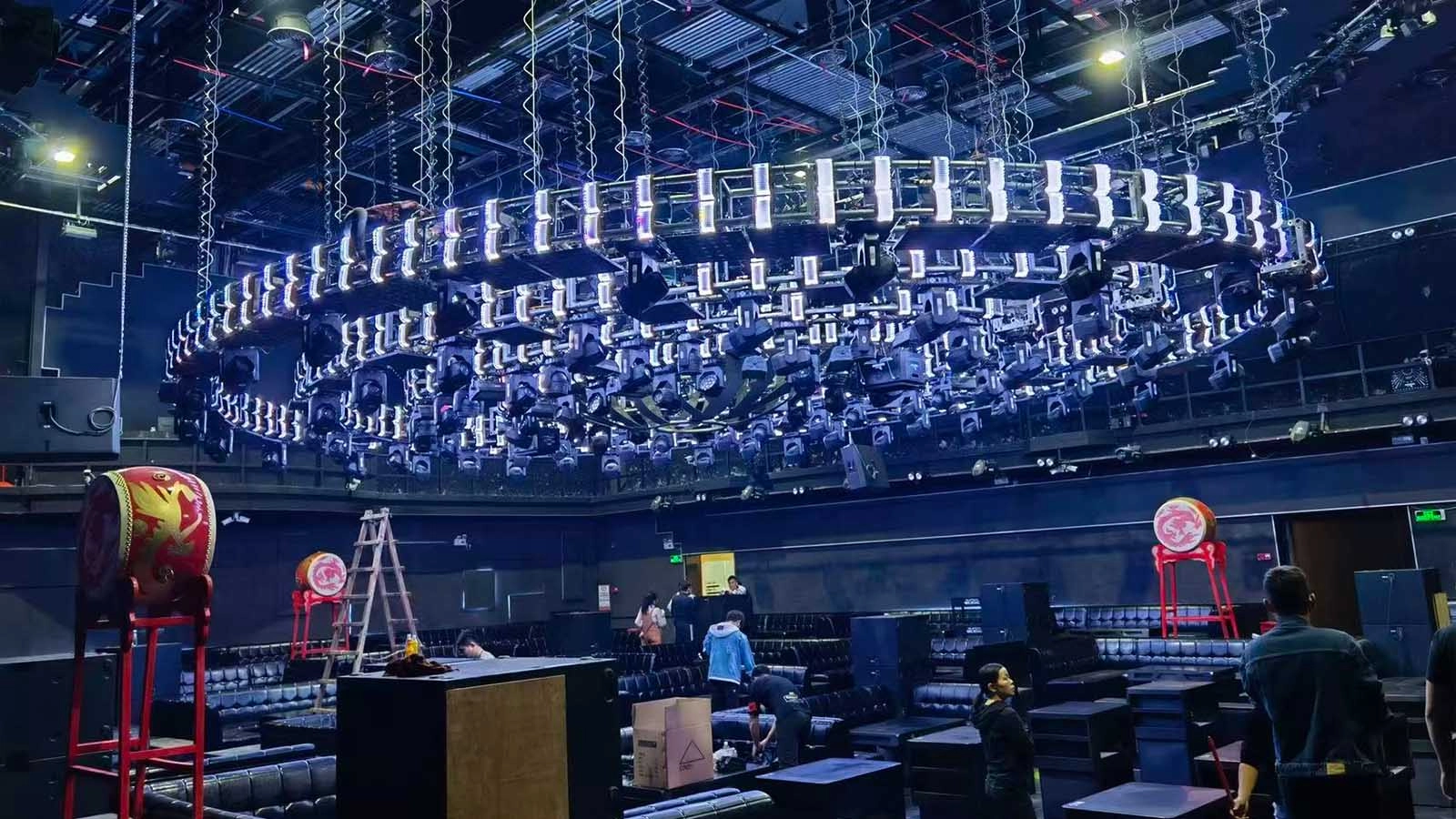
▪ Power-On Sequence: First turn on the main power → power of distribution boxes → console → luminaires to avoid instantaneous current impact;
▪ Commissioning Content: Test the "on/off, brightness, and angle adjustment" of each luminaire one by one, confirm that all luminaires can be controlled normally by the console, record abnormalities (e.g., "The color temperature adjustment of color light L5 fails, and the signal cable needs to be reconnected"), and repair them on the spot.
Kinetic Lighting Installation FAQs
Project buyers usually need to confirm the required site information, local contractor responsibilities, available installation support, commissioning scope, and technical handover before scheduling venue work
Wedding & Parties Lighting Solutions
What information is required before installation planning?
Provide the venue drawings, clear height, suspension or structural information, equipment list, quantities, power conditions, control platform, access restrictions, project location, local contractor scope, and target dates. The team can then identify missing inputs and confirm the installation support required.
Can FENG-YI provide on-site installation support?
Installation guidance and technical support can be discussed for each project. On-site availability depends on location, schedule, system scope, local access, travel requirements, and contractor responsibilities. The confirmed proposal should state what FENG-YI, the customer, and local professionals will provide.
Who confirms structural, rigging, and electrical compliance?
FENG-YI can provide product weights, rated loads, mounting information, power data, and connection requirements. Qualified local structural, rigging, electrical, and safety professionals should review the approved design, venue conditions, equipment documentation, and applicable regulations before installation and acceptance.
After-Sales Support
Can programming and commissioning support be included?
Programming coordination, addressing support, functional testing, movement checks, and system setup guidance can be included according to the confirmed scope. Share the controller, console, channel plan, required scenes, integration needs, and local operator responsibilities so the deliverables and schedule can be defined.
What is included in the technical handover?
The handover can include the confirmed equipment list, addressing information, configuration records, test notes, operating guidance, maintenance recommendations, and support contacts. Warranty and replacement terms should be confirmed by product model, custom scope, order agreement, and the applicable service policy.
Plan Your Kinetic Lighting Installation
Send the venue drawings, ceiling height, suspension information, equipment list, quantity, power conditions, control platform, access restrictions, local contractor scope, project location, and target dates. FENG-YI can review the requirements and respond with installation questions, scope recommendations, technical information, and quotation details based on the confirmed project.
Rest assured that your privacy is important to us, and all information provided will be handled with the utmost confidentiality.
By clicking "Send your message," I agree to your processing my personal data.
To see how to withdraw your consent, how to control your personal data, and how we process it, please see our Privacy Policy and Terms of Use.

Global Kinetic Lighting Solution Partner for Creative Industries
Contact
Address
Building 5, No. 34, Fuyuan Road, Jinghu IndustrialZone, Xinhua Town, Huadu District, Guangzhou, China.
© 2026 FENG-YI. All Rights Reserved.
Facebook
Instagram
YouTube
TikTok
FENGYI Kinetic Lights Solution